
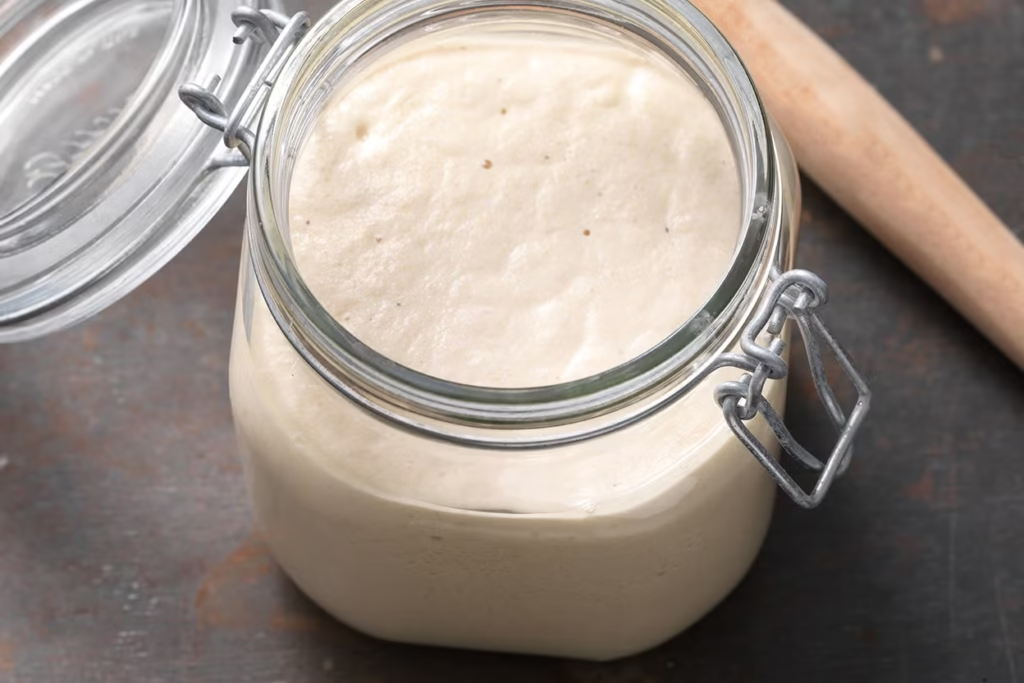

A gluten free sourdough starter is a combination of gluten free flour, water, and captured wild yeast from the environment that can be used in recipes to naturally rise dough without commercial yeasts or leaveners.
It is the same as a “regular” wheat sourdough starter, but the glutinous grains are replaced with gluten free grains.
Flours you can use:
You can actually use a variety of different flours or even a combination of flour when creating your starter.
- Buckwheat
- Brown rice flour
- Sweet rice flour
- Sorghum flour
- Gluten free flour blends like Bob’s Redmill or King Arthur for example. Some people suggest not using a gluten free 1 for 1 type of flour due to the fact that they contain starches and gums. I have tried it with the King Arthur brand and it worked really well.
- Teff
- Millet
Flours not to use:
- Oat
- Quinoa
- Amarath
Tools you may need:
Glass bowl or large glass jar – You want to use non-reactive supplies. Glass is the perfect option for this. While technically stainless steel is non reactive, most sourdough enthusiasts would recommend avoiding all metals.
Wooden spoon or silicon spatulas are your best option. Some people say to stay away from metal utensils when mixing starter, but I’ve never had an issue with that.
Towel, coffee filter, piece of cloth, or even a paper towel (although not my favorite option as it tends to stick to the lid).
Berkey water filter – Sourdough doesn’t like chlorine as it can inhibit the wild yeast and good bacteria from flourishing. Filtering the water is a simple way to combat this, plus drinking filtered water is much healthier.
FAQ
Is a sourdough starter gluten free?
Regular starter made with wheat flour is not. Even though it contains less amounts of gluten through the process of fermentation, it does still contain some. Using a gluten free flour from the beginning will give you a true gluten free sourdough starter.
Is Sourdough OK for gluten intolerance?
This depends on the type of sensitivity you have. Those who have celiac disease cannot have any amount of gluten, so they will not be able to tolerate sourdough products made with regular flour.
However, they would be able to tolerate gluten free sourdough products made with gluten free sourdough starter.
Some people with a gluten sensitivity may be able to tolerate long fermented (8-24 hours or longer) sourdough products. This is because during the fermentation process the wild yeasts, bacteria, and lactic acid breaks down the gluten (while making it more sour), making the end product contain less gluten that is easier to digest than non-fermented wheat products.
What type of flour is best for a gluten free sourdough starter?
You can use any of these gluten free grains: buckwheat, teff, millet, rice, sorghum.
I have also seen on King Arthur Flour and Bob’s Red Mill websites that they have recipes using their 1-for-1 gluten free flours.
White or brown rice flours may yield a more bubbly starter.
I used buckwheat for my starter, because many of the other flours were sold out, and I could get my hands on it quickly.
Another option would be to combine half buckwheat flour with half rice flour, or any combination of the approved flours.
Can I feed my sourdough starter with gluten free flour?
If you have a regular, glutenous starter, I wouldn’t recommend just feeding it gluten free flour. While you definitely could do this, it would still contain some gluten, so your sourdough creations would not be completely gluten free.
Can you convert sourdough starter to gluten-free?
This is definitely possible. While it would still contain trace amounts of gluten, eventually after enough feeding with gluten free flour, a regular starter would be transformed into a “gluten free sourdough starter.” But, then again may have traces of wheat still contained in the gf starter. So if you have celiac or an allergy I wouldn’t recommend going this route.
What is the liquid on top?
Sometimes a liquid forms on top. This is called hooch. This will form when it has been too long since it was fed last, or if your starter isn’t very strong. It’s your starter telling you it is hungry.
You can just pour it off and feed the starter.
Why do you discard sourdough starter?
Removing half of the mixture ensures that the right amount of flour and water is feeding the growing colony of beneficial yeast. If you weren’t discarding half, the 1/4 cup of flour wouldn’t be enough to feed them on days three and four.
You would end up with a lot of extra, immature starter by the end of the process. It wouldn’t be able to make bread or cinnamon rolls rise.
How To Make A Gluten Free Sourdough Starter From Scratch
Day 1: Mix Flour And Water Together
- Mix 1/4 cup flour and 1/4 cup filtered water in a clean jar or glass bowl.
- Stir vigorously, scraping down the sides of the jar and incorporating everything.
- Place a clean tea towel or coffee filter over the bowl or jar with a rubber band and set aside at room temperature or a warm place for 24 hours.
This is a 100% hydration starter. Meaning when you continue to feed the starter you will use 1 part flour, 1 part water, 1 part starter.
Day 2: Discard Some Starter, Then Feed
- The next day, discard half of the starter.
- Add 1/4 cup gluten free flour, 1/4 cup water, stir vigorously, and cover.
- Set aside for 24 hours.
Day 3, 4, & 5: Discard Some Starter, Then Feed
- Repeat the day two instructions for days three, four, and five:
- Discard 1/2 of the starter.
- Feed 1/4 cup gluten free flour and 1/4 cup water. Stir vigorously. Scrape down the sides.
- Cover and set aside for 24 hours.
Day 6 & 7:
On days six and seven, do the same discarding and feeding as the other days, but feed it every 12 hours instead of every 24.
By day seven, there should be enough beneficial bacteria and yeast present to make some sourdough goodies like biscuits, or muffins. But it may not be active enough to make, say bread. It can take a couple more weeks before it is really active enough to create gluten-free bread.
How can you tell it is ready?
You will know it’s ready if it has lots of bubbles, and doubles in size after a few hours when fed.
Unfortunately, gluten free starter doesn’t pass the float test like a regular wheat active starter would. So determining if it is ready will be based on appearance and if it is bubbly and doubling in size.
Maintaining And Feeding Your Starter:
If you are planning to bake a lot with your starter, you can leave it on the counter and feed it every 12 hours equal parts GF flour and water. Or else, place it in the fridge with a lid and feed every 7 days.
When you are ready to bake with it, remove it from the fridge, feed it, and then wait 4-12 hours (until it is about doubled in high and is bubbly). Happy baking.
How much flour and water should I feed my starter?
If you have a cup of starter, you will need to feed it 1 cup of flour and 1 cup of water. If you have 1/2 cup of starter, then you can feed it 1/2 cup flour and 1/2 cup of water.
Does that make sense? You don’t want to feed 1 cup of starter 1/4 cup of flour and water. It will be hungry.
If you have too much starter, discard it or use it in discard recipes.
Once your starter is well established, you don’t need to always discard it before feeding it. You can either use the discard in recipes or feed it. As long as it is fed enough flour and water, it should stay nice and happy.
If you are planning to only bake once a week or so, you can store your gluten free starter covered in the fridge and feed it equal parts water and flour once a week.
Pull the starter out of the fridge to feed it about 12 hours before you plan to use it.
What to make with a gluten free starter:
- Pancakes
- Muffins
- Cake
- Bread
- Scones
- Brownies
- Cookies
- And more
Gluten Free Sourdough Starter
Additional Time:7days days
Total:7days days
Servings: 1 gluten free sourdough starter
Ingredients
- Flour, buckwheat, teff, millet, rice, or sorghum. You may even be able to use a gluten free one-to-one flour blend.
- Filtered water
Instructions
- Day 1: Mix Flour And Water Together
- Mix 1/4 cup flour and 1/4 cup filtered water.
- Stir vigorously, scraping down the sides and incorporating everything.
- Place a clean tea towel over the bowl and set aside for 24 hours.
- Discard half of the mixture.
- Add 1/4 cup gluten free flour, 1/4 cup water, stir vigorously, and cover.
- Set aside for 24 hours
- Day 3, 4, & 5: Discard Some Starter And Fee
- Repeat the day two instructions for days 3-5.
- Cover and set aside for 24 hours.
- Day 6 & 7:On days six and seven, do the same discarding and feeding as the other days, but feed it every 12 hours instead of every 24.
- By day seven, your starter should contain enough wild yeast and beneficial bacteria to be able to bake with.
Notes
- It may take a little longer for your gluten free sourdough starter to take off and really start to get bubbly, especially if you use buckwheat.
- It is best to use filtered watered when feeding and maintaining your starter. I use a Berkey Water Filter, but any filtered water will do. The chlorine in city water may kill or inhibit the wild yeast and good bacteria growth.


Pingback: Homemade Gluten-Free Sourdough Pizza - recipes.footballjet.com
Pingback: Gluten-Free Sourdough Discard Mini Pecan Pie Cookies - recipes.footballjet.com