
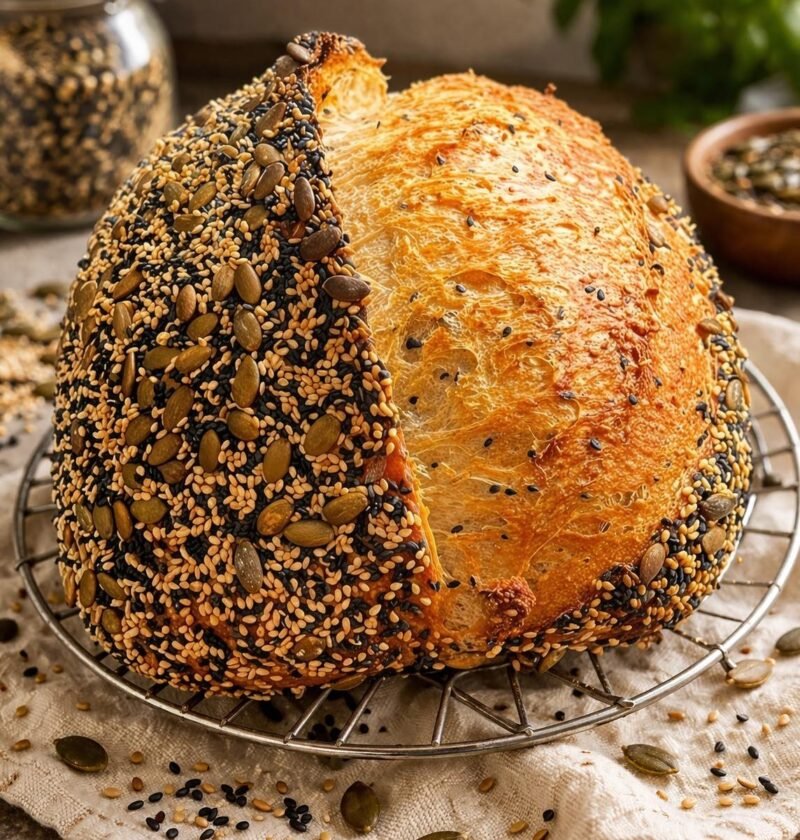

This homemade multi-seed sourdough bread is one of those loaves that makes your kitchen smell amazing. It has a golden, crispy crust, a soft and chewy inside, and a delicious mix of seeds throughout the dough. It’s easy enough for beginners and works beautifully for sandwiches, toast, or simply spreading with butter.
🥖 Recipe Details
Prep Time: 30 minutes
Resting & Fermentation: 8–12 hours
Bake Time: 40–45 minutes
Total Time: About 9–13 hours
Servings: 1 large loaf
Difficulty: Easy to Moderate
Ingredients
For the Dough
- 100 g active sourdough starter
- 350 g warm water
- 500 g bread flour
- 10 g fine sea salt
- 60 g mixed seeds
Recommended Seed Mix
You can use any combination you like. A good mix is:
- 20 g sunflower seeds
- 15 g pumpkin seeds
- 10 g sesame seeds
- 10 g flaxseeds
- 5 g chia seeds
Optional: Reserve 1–2 tablespoons of seeds for sprinkling over the top.
Instructions
1. Mix the Dough
Add the active sourdough starter and warm water to a large mixing bowl. Stir until the starter is mostly dissolved.
Add the bread flour and mix with a wooden spoon or your hands until there are no obvious dry patches.
Cover the bowl and let the dough rest for 30 minutes.
2. Add the Salt
Sprinkle the salt over the dough.
Wet your hands and gently squeeze and fold the dough several times until the salt is evenly incorporated.
The dough may feel sticky at first, but it will become smoother as you work with it.
3. Add the Seeds
Add the mixed seeds and gently fold them into the dough.
Try to distribute the seeds evenly without tearing the dough.
4. Stretch and Fold
Over the next 2 hours, perform about 4 sets of stretch-and-folds, roughly every 30 minutes.
To do one fold, grab one side of the dough, stretch it upward gently, and fold it over the center. Turn the bowl and repeat on all four sides.
As the dough develops strength, it should become smoother and hold its shape better.
5. Bulk Fermentation
Cover the bowl and leave the dough at room temperature until it looks noticeably puffed and has increased in size by around 50–75%.
Depending on your room temperature and starter strength, this can take approximately 4–7 hours.
Don’t rely only on the clock. Look for bubbles around the edges, a slightly domed surface, and a lighter, airier feel.
6. Shape the Loaf
Lightly flour your work surface and gently turn the dough out.
Shape it into a loose round, then let it rest uncovered for about 15–20 minutes.
Shape it again into a tighter round by gently pulling the dough toward you across the counter to create surface tension.
Place the dough seam-side up into a well-floured banneton or a bowl lined with a floured kitchen towel.
7. Cold Proof
Cover the dough and place it in the refrigerator for 8–12 hours.
The cold fermentation develops a deeper sourdough flavor and makes the dough easier to score and bake.
8. Preheat the Oven
Place a Dutch oven with its lid inside your oven.
Preheat to 450°F (230°C) for at least 30–45 minutes.
9. Score the Bread
Carefully turn the cold dough onto a piece of parchment paper.
Brush away any excess flour if needed.
Use a sharp bread lame or razor blade to make one deep slash across the top.
If desired, sprinkle a few extra seeds over the surface.
10. Bake
Carefully transfer the dough into the hot Dutch oven.
Cover with the lid and bake for 20 minutes.
Remove the lid and reduce the temperature to 425°F (220°C).
Continue baking for another 20–25 minutes, or until the loaf is deeply golden brown.
For a well-baked loaf, the internal temperature should be around 205–210°F (96–99°C).
11. Cool Completely
Remove the bread from the Dutch oven and place it on a wire rack.
Allow it to cool for at least 1–2 hours before slicing.
This is important because the inside continues to set as the loaf cools. Cutting it too early can make the crumb gummy.
Tips for Perfect Multi-Seed Sourdough
Use an active starter: Your starter should be bubbly, lively, and able to rise significantly after feeding.
Don’t add too many seeds: Seeds can weigh down the dough. Around 60 g gives you plenty of flavor without making the loaf overly dense.
Toast the seeds: For extra flavor, lightly toast the sunflower, pumpkin, and sesame seeds before adding them. Let them cool completely first.
Watch the dough, not the clock: Fermentation time changes depending on room temperature, flour, starter strength, and water temperature.
Don’t skip the cooling time: A beautiful loaf needs time to finish setting before slicing.
For a softer crust: Once the bread has cooled, store it in a bread bag or airtight container.
Easy Seed Variations
You can change the seed combination depending on what you have available.
Try:
- Sunflower + pumpkin + sesame
- Flax + sesame + chia
- Pumpkin + sunflower + flax
- Sesame + poppy + sunflower
- Sunflower + pumpkin + hemp seeds
For a slightly sweeter loaf, you can also add a small amount of honey or maple syrup.
How to Store
Keep the completely cooled bread at room temperature in a bread bag or paper bag for up to 3 days.
For longer storage, slice the bread and freeze it in a freezer-safe bag for up to 3 months.
You can toast individual slices directly from frozen.
Frequently Asked Questions
Can I use whole wheat flour?
Yes. Replace up to about 100–150 g of the bread flour with whole wheat flour. You may need to add a little extra water because whole wheat flour absorbs more moisture.
Do I need to toast the seeds?
No. You can add them raw. Toasting is optional but gives the seeds a deeper, nuttier flavor.
Can I use only one type of seed?
Absolutely. Sunflower seeds, pumpkin seeds, sesame seeds, or flaxseeds can each be used on their own.
Why is my sourdough bread dense?
The most common reasons are an inactive starter, under-fermentation, or cutting the loaf before it has completely cooled.
Can I make this without a Dutch oven?
Yes. A Dutch oven makes it easier to create steam, but you can bake the loaf on a preheated baking stone or sheet while adding steam to the oven during the first part of baking.
How do I know when my sourdough is ready to bake?
The dough should look noticeably expanded and airy, with bubbles visible around the edges. When gently pressed, it should slowly spring back rather than immediately filling the indentation.
Final Thoughts
This Easy Homemade Multi-Seed Sourdough Bread is a great everyday loaf when you want something wholesome, flavorful, and satisfying. The combination of crunchy seeds and naturally fermented sourdough makes every slice delicious.
Serve it warm with butter, use it for sandwiches, or toast it and top it with avocado, eggs, cheese, or your favorite spread. Once you make this loaf a few times, it’s easy to adjust the seed mixture and make it your own.


